Mastering Momentum Optimization: Visualizing Loss Landscapes & Escaping Local Minima

Understanding the Graphs: 2D, 3D, and Contours

In Deep Learning, whether we are working on a regression problem or a complex neural network, we rely on the Loss Function. It serves as the bridge between the true labels and our model's predictions, telling us exactly how accurate (or wrong) we are.
But how do we actually visualize this?
The Relationship: Weights, Biases, and Loss
Before looking at the graphs, we need to understand the chain reaction:
The Loss is a function of our Weights (w) and Biases (b).
When the loss is high, the model is performing poorly.
To fix this, we update the weights and biases.
As these parameters change, the prediction changes, and consequently, the loss value changes.
We can plot this relationship to see exactly how adjusting the parameters affects the error.
Visualizing the "Unseeable"
Humans are limited by what we can see with the naked eye. This dictates how we graph these functions:
1 Parameter (2D Graph): If we are tuning just one parameter, we get a simple 2D curve (like a parabola).
2 Parameters (3D Graph): If we have two parameters, we get a 3-dimensional surface. We can clearly see the peaks (high loss) and the valleys (low loss).
3+ Parameters: In real deep learning, we have millions of parameters (Higher Dimensional Space). We cannot visualize this with the naked eye. However, the intuition we gain from the 3D graph applies mathematically to these higher dimensions.
Decoding the Contour Graph (The "Top View")

Since 3D graphs can be hard to read on a flat screen, we use Contour Plots. A contour plot is simply the projection of a 3D graph onto a 2D plane—imagine looking at a mountain from directly above (a bird's-eye view).
Here is how to interpret the colors and lines:
The Concentric Circles (Altitude): Each ring represents a specific "altitude" or loss value. If you walk along one specific ring, your loss remains exactly the same.
The Shades (Depth): The colors are the 3D depth imposed on a 2D surface. Darker or distinct shades often represent deeper valleys (lower loss), while lighter shades might represent higher peaks.
The Gradient: The transition between shades tells us about the slope. If the rings are packed tightly together with rapid color changes, the slope is steep. If they are far apart, the area is flat.
Convex vs. Non-Convex Optimization

When we build complex neural network architectures in Deep Learning, the resulting Loss Function graph becomes highly complex.
In simple regression, we often get a Convex function (like a perfect bowl), where there is only one minimum—the bottom. It is easy to solve. However, Neural Networks produce Non-Convex functions. These landscapes are rugged, full of hills and valleys, making it extremely difficult to reach the Global Minimum (the optimal solution).
The Three Hurdles in Non-Convex Optimization
Standard Gradient Descent struggles to navigate this terrain. There are three primary reasons why we fail to reach the optimal solution:
1. Local Minima (The Trap) A local minimum is a point where the slope (gradient) is zero, just like the global minimum. If we initialize our weights poorly, the optimizer might fall into one of these shallow valleys and get stuck. It thinks it has finished learning because the slope is zero, but it has actually settled for a sub-optimal solution.
2. Saddle Points (The Plateau) A saddle point is tricky because the surface curves up in one direction and down in another (like a horse saddle).
The Problem: Around a saddle point, the gradients become very small (almost zero) in certain directions.
The Result: This makes training incredibly slow. The optimizer "crawls" through these regions, wasting valuable training time.
3. High Curvature (The Ravine)

High curvature usually occurs in narrow ravines or valleys. In these areas, the gradient changes very rapidly. Standard Gradient Descent struggles here—it tends to bounce back and forth across the ravine rather than moving down along the valley floor. It simply cannot navigate these sharp turns efficiently.
Why Use Momentum Optimization?
Because of the complex, non-convex nature of our loss landscape, "Vanilla" (Standard) Gradient Descent is often insufficient. It gets stuck in local minima, slows down at saddle points, and struggles with high curvature.
Furthermore, we often deal with Noisy Gradients. In Mini-batch Gradient Descent, our calculated gradients fluctuate wildly because we are looking at small subsets of data rather than the whole dataset.
Momentum Optimization is designed specifically to navigate these three problems. It acts as a smoothing factor—dampening the noise and helping the optimizer power through local minima and saddle points to reach the true global minimum.
What is Momentum Optimization ?
To understand Momentum, we can look at two simple analogies: The Driver and The Ball.
1. The Confident Driver
Imagine you are driving from Point A to Point B, but you don't know the way. You stop to ask people for directions.
Consistent Advice: If five people in a row point you in the exact same direction, you gain confidence and drive faster.
Conflicting Advice: If one person points left, the next points right, and another points back, you lose confidence. You drive slowly and cautiously.
Momentum works the same way. If the gradients (directions) are consistent over time, the algorithm "gains confidence" and accelerates. If the gradients are noisy (conflicting), the momentum dampens the speed, preventing us from going astray.
2. The Ball on a Hill
Think of a ball rolling down a hill. As it rolls, it doesn't just move based on the slope of the ground right now; it carries the velocity from the previous moment. It builds up speed. Even if it hits a small bump (local noise), its heavy momentum allows it to power over the bump and keep going.
The Core Idea: If our previous gradients moved us in a specific direction, we confidently increase our speed in that direction. The single most important benefit of Momentum is speed—it is significantly faster than Vanilla Stochastic Gradient Descent (SGD).
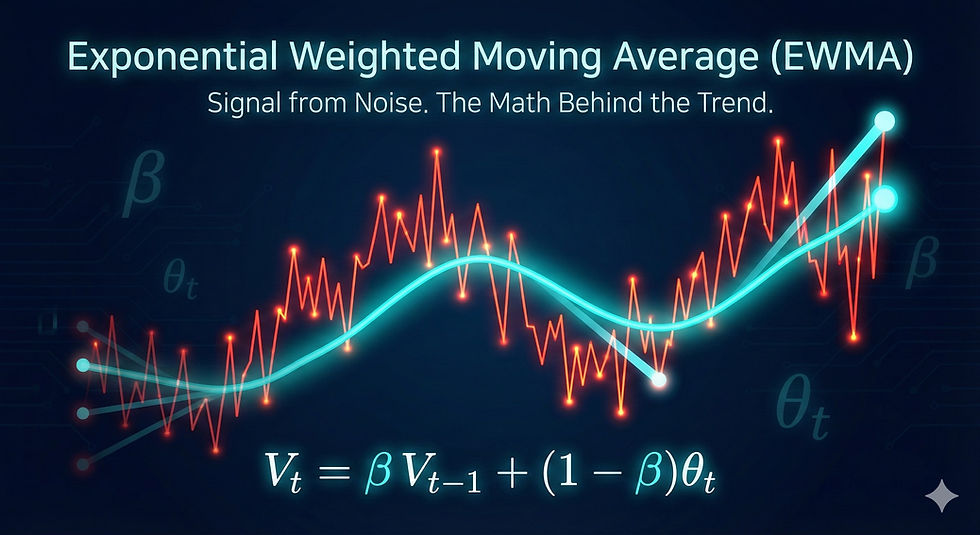
The Mathematics: Exponential Weighted Moving Average
Mathematically, Momentum relies on something called the Exponential Weighted Moving Average (EWMA). Instead of just taking the current step, we take an average of the past steps, with recent steps mattering more.
In normal Gradient Descent, we simply update weights using the gradient. In Momentum, we introduce a velocity term (v).
The Update Rule:
vₜ = β vₜ₋₁ + η ∇ wₜ
wₜ₊₁ = wₜ − vₜ
Where:
vₜ : The current velocity.
vₜ₋₁ : The velocity at the previous step (the "history").
β (Beta): The momentum factor (usually 0.9).
η (Eta): The Learning Rate.
∇ wₜ : The current gradient.
Breaking it Down:
The term β vₜ₋₁ is the Momentum Component. It represents the history of our past velocities. By adding this history to our current gradient, we get "acceleration." If the past update and current update are in the same direction, they add up, and the step size increases.
Solving the "Zig-Zag" Problem

One of the biggest issues with standard Gradient Descent is the "Zig-Zag" movement.
When navigating an error surface (especially in ravines), the gradient often oscillates wildly in the vertical direction (steep slopes) while making very slow progress in the horizontal direction (towards the minimum). This zig-zagging wastes time and slows down convergence.
How Momentum Fixes This:
Vertical Direction: Because the gradients oscillate (up/down, positive/negative), the momentum term averages them out. The positive and negative history cancel each other, reducing the zig-zag.
Horizontal Direction: Since the gradients are consistently pointing toward the minimum, the momentum adds up.
Result: We minimize the useless vertical oscillations and maximize the useful horizontal speed. This is why Momentum converges much faster.
The Effect of Beta (β): Tuning the Friction
Recall our Momentum update rule:
Vₜ = β Vₜ₋₁ + η ∇ wₜ
The hyperparameter β (Beta) acts as a decaying factor. It controls how much "history" we keep versus how much the "current" gradient matters. It essentially governs the friction of our surface.
Interpreting Beta
If β = 0 : The momentum term vanishes. We are left with Vₜ = η ∇ wₜ , which is just standard Gradient Descent (GD). The "history" is ignored completely.
If β = 1 : There is no decay. The algorithm enters a state of dynamic equilibrium, moving like a puck on friction-less ice. It will never slow down or converge.
The Sweet Spot (β = 0.9): In practice, we typically set β to 0.9.
The Rule of Thumb: The approximate number of past steps that contribute to the average is given by 1/(1−β) .
If β = 0.9, then 1/(1−0.9) = 10. This means the algorithm is effectively taking the moving average of the past 10 gradients.
The Race: Vanilla SGD vs. Momentum
If we visualize two balls dropping onto our loss surface, we can clearly see the difference:
The Blue Ball (Vanilla SGD): It moves solely based on the current slope. It is slow. If it encounters a small valley (Local Minimum), it gets stuck because the slope there is zero. It has no energy to push itself out.
The Purple Ball (Momentum): It builds up velocity as it rolls down.
Speed: It reaches the bottom much faster than the blue ball.
Escaping Local Minima: This is the biggest advantage. Because the purple ball has accumulated momentum (velocity from previous steps), it has enough kinetic energy to roll right through small local minima and continue toward the global minimum.
The Problem with Momentum: Overshooting
However, the algorithm's greatest strength—its speed—is also its main weakness.
Imagine a car speeding down a hill toward a destination. Because it is moving so fast, it might miss the parking spot, hit the brakes, reverse, and wiggle back and forth before finally stopping.
This is exactly what happens in Momentum Optimization:
Because the momentum term carries the history of past high speeds, the optimizer often overshoots the global minimum.
It doesn't stop instantly at the bottom; it rolls past it, then has to turn around.
This causes Oscillations around the minimum before it finally settles (converges).
The Takeaway: While Momentum gets us to the vicinity of the solution much faster than SGD, it can sometimes take longer to settle at the exact bottom because of this overshooting.